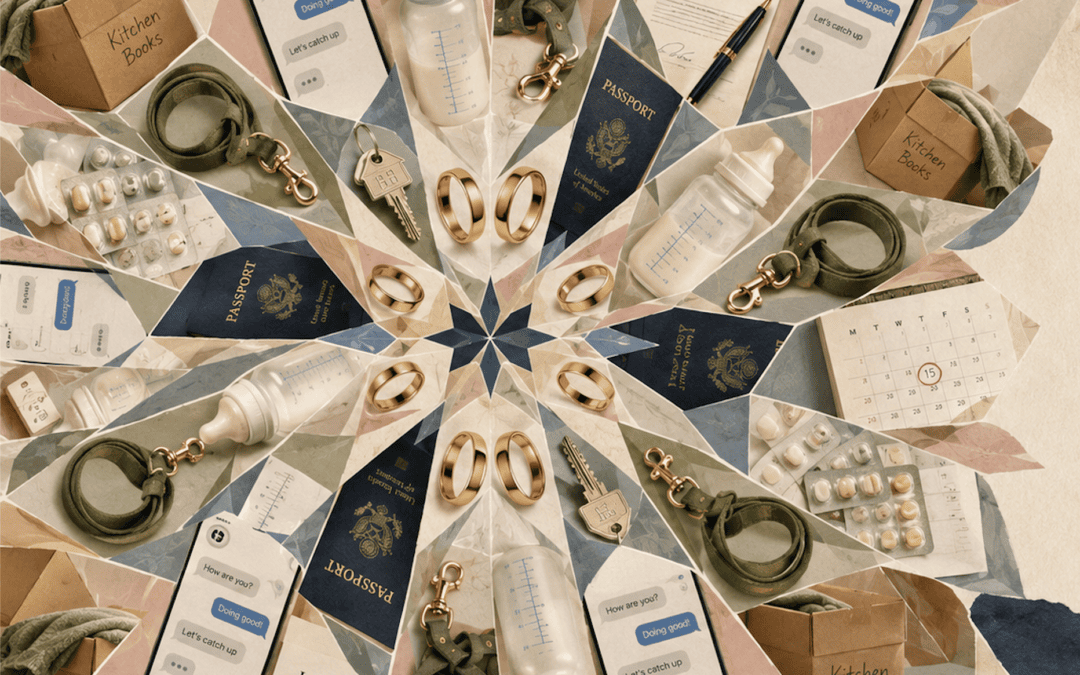
The next category gets built in the gap between the event people announce and the change they feel first.
I’ve spent years researching the beauty industry’s ageing conversation. From all my conversations with women, I’ve learned that it is rarely the milestone that makes ageing products feel relevant. I have never heard a woman describe deciding it was time as a birthday. More often, the real moment is smaller and quieter: a reflection in a shop window that triggered a second look, a comment from a friend or stranger, a photograph that looked more like her mother than herself. That is when the decision turned.
Most categories have not caught up to this reality yet.
Brands have always loved a life event because it is a moment of reassessment. A wedding has a registry. A baby requires a buggy, clothing, toys, everyday items. A house triggers a mortgage and rooms that need furniture. For most of modern consumer marketing, this was the dream. A customer whose life had just rearranged, making them more open to new possibilities.
That was the logic behind milestone marketing, and much of the innovation built around it. Leverage the moment to trigger new habits. Find the moment someone is considering, or forced, to buy differently, and you can become part of the next version of their life. IKEA made this literal in 2018, with a print advert for a crib that doubled as a pregnancy test. For a long time, targeting the moment was enough.
Lots of brands have updated their list of life milestones. IVF journeys, sober anniversaries, leaving marriages, running a first 10k. The problem is that updating the list of milestones does not question the map underneath. It still assumes life moves through discrete, recognisable stages. That is not how adult life feels today.
For most of the last century, adulthood followed a recognisable sequence. Education, work, partnership, a home, children. Not everyone lived it, but enough people did that it functioned as a shared structure. Milestones only make sense if life is a straight road of sameness. And the map for that road, the shared coordinates, the comparable timelines, no longer describes the lives people are moving through.
If life is more like a kaleidoscope than a road, we need a different language. Not milestones, but life turns.
A life turn is the moment the pattern changes, whether or not anything has happened publicly. Some turns are planned. Many are not. Some arrive as opportunity; others arrive as loss. Some feel significant at the time; many are only legible in retrospect. Starting a business can be a turn. So can closing one. Moving country can be a turn. So can staying where you are and becoming a different person inside the same home.
The things that change the shape of a life often do not arrive as public events. A milestone gives a brand both an audience and a product brief in the same moment. A turn gives neither. You have to go deeper to understand what someone needs before they have a name for it themselves.
Brands were built around the milestone. The smartest are learning to build for the turns of modern adulthood.
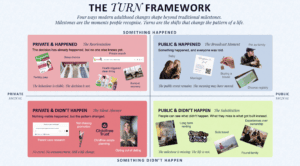
The Turn Framework
Twenty-five years in qualitative research teaches you that the most important signal is not always what someone says. It is what they repeat without naming, what they stop doing without announcing, what they avoid, postpone, replace or quietly decide against.
A person who mentions a decision three times has told you something. A person who stops doing something they have always done has told you something else. And a person who never chooses the thing everyone expected them to choose has told you something too.
It also changes where a brand can see the signal. Some turns leave public records. Some leave search and purchase trails. Some only become visible through the lives people build around the missing milestone. And some may only appear in the private sentence before anyone has decided what to do.
That gives four kinds of turn, each with a different kind of signal.
Public & Happened: The Broadcast Moment
This was the easiest turn for brands to read because it left evidence in public. The announcement, the registry, the hospital gift pack, the mortgage, the loyalty-card basket filling with nappies and formula, the rooms that suddenly needed furniture. The life change was socially visible and commercially legible at almost the same time.
But even this quadrant is changing, because the visible event no longer carries the same product brief.
The wedding still happens, but the home often comes first. Furniture accumulates across a decade of independent living, renting, flat-sharing or co-living, long before any wedding. Which is why the wedding list has increasingly become an ask for cash instead of a kettle. Zola and Honeyfund did not simply market to modern couples differently. They built a product that let money become a socially acceptable gift. The public event remained. The need inside it had moved.
The dog sits here too, but for a different reason. Nobody hides a dog. It is visible the moment it exists. What stays private is the reason behind it: rehearsal, substitute, delay tactic, or the whole family. Rover’s 2026 generational pet parenthood report found millennial pet parents were seventeen times more likely than boomers to say they had delayed children and got a pet instead. The signal is visible in pet ownership and spending. The turn underneath is harder to name.
Divorce also sits at the edge of this quadrant. Once it happens, it is visible. But for decades it was commercially under-ritualised, with no equivalent of the wedding list, no easy script for other people to participate. Fresh Starts Registry built the divorce equivalent of a wedding registry: not a campaign about starting again, but infrastructure for a transition nobody had properly designed for.
Visible & Done is still the easiest type of turn to market to. It is also where the danger of old thinking is clearest. Brands can see the event and assume they understand the need. Increasingly, they do not.
Private & Happened: The Reorientation
This is where the decision has happened, but no one else knows yet.
Brands can see this turn through behaviour: search terms, subscriptions, new shopping baskets, symptom language, Reddit threads, TikTok saves, product swaps.
Starting to try for a baby sits here. First a private search, then perhaps one friend, then a small circle, then, if it goes well, everyone at once. If it does not, often no one at all needs ever know. Perelel, Needed, Natalist, Bird&Be and Beli have built around exactly that arc: subscription supplements and preconception packs for a customer who may have told no one but herself. The public milestone is pregnancy. The private turn is deciding to try.
The same pattern shows up after a health diagnosis, when the washing powder, frying pan, moisturiser and food in the fridge all become suspect at once. The turn is not simply “I need cleaner products.” It is: I no longer trust the world I was living in. That private reorientation has helped drive clean beauty, clean-label food, non-toxic home products, air purifiers and ingredient literacy. The illness may be private. The product trail is not.
There are smaller versions of this everywhere. A couple starts sleeping in separate beds but never announces it. Someone begins researching financial protection or solo travel long before it becomes visible. Each of these is an innovation and product opportunity.
This is the quadrant search made valuable. It lets brands see fragments of the life turn, but fragments are not the whole turn.
Public & Didn’t Happen: The Substitution
These are the turns culture tends to misread.
It sees the missing event and assumes lack. Not married. Not a homeowner. Not a parent. Not driving. Not moving in. Not climbing the corporate ladder. But many of these absences are no longer simply delays on the way to the expected thing. Some are refusals. Some are substitutions. Some are economic adaptations that have hardened into identity. Some are lives being built around a different centre of gravity altogether.
This is where brands need to read what people are building instead.
The person not buying a house may not be waiting patiently for the mortgage market to let them in. They may be spending on travel, interiors for rented homes, experiences, wellness, or a version of adulthood that does not require ownership to feel legitimate.
The single person may not be waiting to be folded into a couple. They may be building a solo life with different needs for housing, money, care, social infrastructure and emergency backup. The visibly childfree adult may not be a parent-in-waiting. They may be building a family system around friends, siblings, nieces, nephews, community, or no dependent structure at all.
The signal here is visible, but not as an announcement. Brands find this turn not by waiting for a declaration, but by watching where money, space, time and care are being redirected. It appears in substitution: one-person households, solo travel, pet spending, long-term renting, chosen-family logistics, experience spending, financial products that do not assume a spouse, and care systems that do not assume adult children will appear at the end.
The mistake is to market to the absence as if it were a wound. That is where the category becomes patronising. The better opportunity is to build for the life already being assembled around it.
This is why visible-and-not-done is not a “missing milestone” segment. It is a substitution segment. The commercial question is not how to console someone for not having the old event. It is what infrastructure their alternative life now requires.
Private & Didn’t Happen: The Silent Absence
This is the hardest quadrant to see because nothing happens, but that is where the innovation opportunity lies.
There is no announcement, no purchase, no form, no obvious behaviour change. The turn is the decision not to do something, or the slow realisation that something expected may never happen.
Researching care homes for a parent because looking is not the same as deciding and saying it out loud feels like a betrayal before anything has actually happened. Turning forty without the children you expected. Deciding privately not to chase the next promotion. Choosing not to date again.
Traditional data struggles here because there is no event to capture. Search catches some of it, but often only when the private unease has already hardened into a question. “Do I need a will if I don’t have children?” “What happens if I never buy a house?” “How do I tell my sibling mum needs help?” By then, the turn is already halfway to becoming a task.
This is where conversation becomes different. Someone may tell an AI, I don’t think I want what I thought I wanted, long before they search for a product, service or professional. Someone may type, I know I should want the promotion but I feel nothing. Or, I think my parent is declining but I can’t say it out loud yet. Or, I thought I would be a mother by now and I don’t know what life is supposed to look like if I’m not.
Those sentences are not consumer queries. They are private reorientations in language: the turn happening before it becomes a decision, a search or a purchase.
Even this quadrant is starting to show innovation at the edges. Childfree Trust launched at CES 2026 to address the seventy percent of childfree adults who have no estate plan at all, a gap its own research calls a $67 billion fiduciary void, because the entire next-of-kin system assumes children. This is not a lifestyle brand. It is infrastructure built for the practical consequences of an absent milestone.
This is where some of the next visible markets will come from: decisions made privately for decades, with no product and no name, until suddenly the absence becomes a category.
Life Turns Move Quadrants
The point is not to place every life turn permanently in one quadrant. The point is to notice which quadrant a turn is about to leave.
Perimenopause shows how turns move. Five years ago, it sat much closer to invisible and unnamed. Women were experiencing symptoms, but there was little public conversation, little retail infrastructure and very little product language, let alone products. Then the ghost market showed itself. Searches rose, Reddit threads multiplied, Naomi Watts launched Stripes, Judy Greer became part of Wile, and Target, Boots and Walmart carved out shelf space for a category that barely existed before.
What was once private became searchable. What was searchable became social. What was social became a shelf. What became a shelf became a category. The global menopause market is valued at over £13 billion and rising.
That movement is the growth signal, not just the innovation signal. Thirteen billion pounds is what noticing it early was worth.
The interesting question for companies is not only where a life choice sits today. It is where it is becoming visible, and whether the market will notice before the category has already been built by someone else.
The Sentence Before the Search
For most of the last century, brands could only see life change once it left evidence: the announcement, the registry, the receipt, the mortgage, the shopping basket, the public proof that something had happened.
Search added an earlier layer. Rising searches for “early signs of perimenopause” or “how do I know if I’m settling” revealed turns before they became choices. But search still only captures the moment after someone has found words for what they need. It holds the query, not the sentence that came before it.
Conversation with AI goes further, and starts earlier.
A woman tells ChatGPT she is trying to conceive before she has told a single friend. Someone types the sentence should I leave my marriage before it is a decision, let alone a search for a new home. Someone writes that they thought they would be a mother by now and no longer know what the rest of adulthood is supposed to look like.
For the first time, a piece of software may hold a private life choice earlier than the person’s own inner circle does, in the same unbroken thread as the reasoning behind it.
That is not an incremental improvement on search. It is a different kind of access entirely.
For decades the way to find a need before it had a name was to talk to someone, to sit in their kitchen and listen, to ask questions. Not just about what they wanted to buy, but the problem they were trying to solve. The life they wanted to create.
Now a conversation thread is doing something adjacent to that at scale, whether anyone designed it to or not. The useful signal is not only the recommendation someone asks for. It is the transition from feeling to plan: the moment private thoughts become exploration, then choice, then action.
Most companies are treating this as a targeting problem: how do we get named inside the answer? That is a marketing question, and it is the smaller one. The larger question is what to build in response to the sentence before it becomes a category anyone else can see.
This does not mean companies should invade people’s most private conversations. That is the dystopian version. The challenge is how to understand the turn without exploiting the person inside it.
Because the companies that win this next phase of adult life will not be the ones with the sharpest campaign. They will not be the ones that rename more milestones. They will be the ones whose product roadmap responds to what is driving life decisions.
Milestone marketing was built around the public event. Turn innovation will be built around the private reorientation of adulthood.
It is harder to see, and easier to mishandle. But it is also where demand is moving.
For a century, brands were trained to wait for the visible turns: the wedding, the mortgage, the birth, the proof that a life had entered a new stage. The commercial problem now is that three of the four types of life turn do not leave that kind of evidence.
The old milestones have not disappeared. Some arrive later. Some arrive out of order. Some never arrive at all. But the turns around them are still happening, and increasingly they are happening before the market can see them.
Most brands are still waiting for the milestone, while life has already turned.
This piece continues a thread that started with “We Expected a Mirror. We Got a Kaleidoscope” then continued with We Updated the Milestones. Nobody Questioned Whether Milestones Were the Problem.”