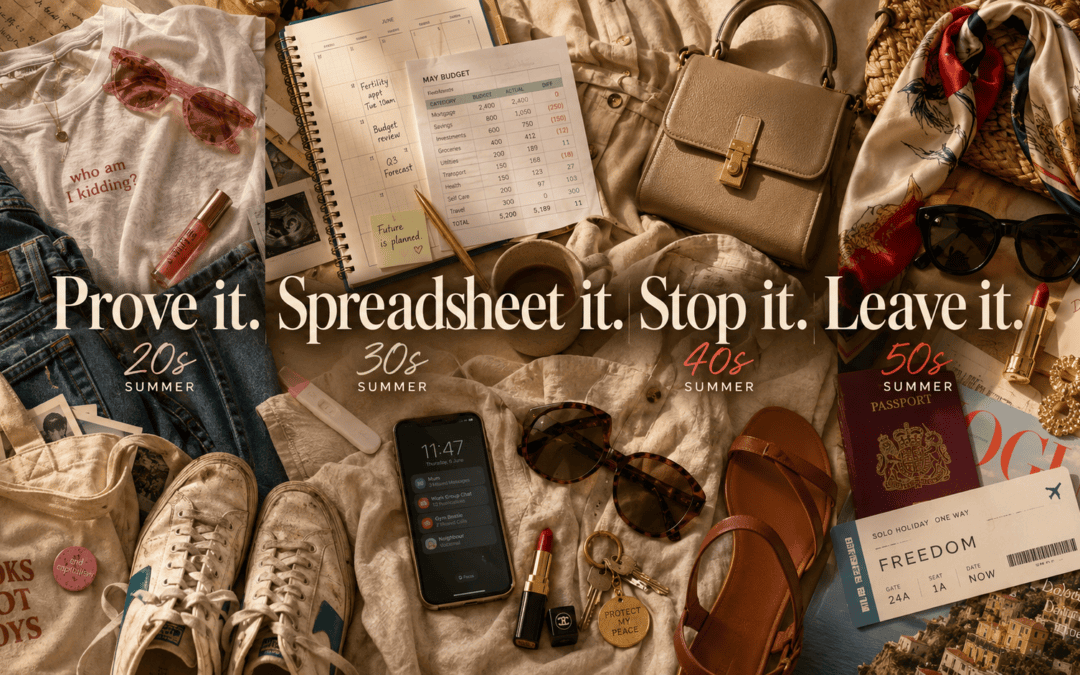
From Prove It to Hot Divorce, the Four Female Moods of 2026
This is the summer women stop trying to have the same summer.
Two summers ago, culture gave us Brat Summer. Lime green, messy, loud, anti-polish. This summer feels different. It’s not producing one dominant female mood. It’s triggering several.
In your 20s: Prove It Summer.
In your 30s: Spreadsheet Summer.
In your 40s: Stop It Summer.
In your 50s: Hot Divorce Summer.
The shared mood is refusal. The expression changes by age.
In your 20s: Prove It Summer
The Prove It Summer wardrobe is not a look. It is a negotiation. Vintage Levi’s that cost less than a cocktail, paired with a sheer white tee and a pop of Klein blue. A tote bag with a slogan nobody asked for your opinion about. Scuffed trainers chosen for function, not the occasion. Second-hand everything, because the high street has to prove it is worthy of full price. Makeup is gloss, frosty lids and playful colour.
Women in their 20s have watched women build their careers, do therapy, freeze their eggs, raise their standards, learn attachment theory, endure the motherhood penalty and discover that love alone does not mean a relationship works.
Before they commit any time, money, effort or energy they want proof.
Prove the job is worth the burnout. Prove the city is worth the rent. Prove the date is worth the effort. Prove the degree is worth the debt. Prove the life path still works.
Everything has to earn its place.
The first rung of the career ladder is being kicked out beneath them. It has not just got harder to reach. For many roles, it is disappearing. UK graduate job postings fell 33% in 2025, the lowest level since 2018, the second consecutive year of decline. At the same time, public confidence in university is weakening: a British Social Attitudes survey found that 34% now think a degree is not worth the time or cost, up from 14% in 2005.
Those in employment are feeling the pressure to perform. Prove It Summer is also about protecting your hours. The concert, the holiday, the evening that belongs to doing nothing.
Dating has to prove itself too. The average all-in cost of a date in the US has climbed to $205 per date. Half of people say those costs interfere with their broader financial goals. The response: solo-maxxing. A deliberate lifestyle choice that’s cheaper, calmer, emotionally lower-risk.
Beyond money, partners need to earn something harder to quantify: headspace, attention, willingness to be known. Tinder’s 2026 dating trend of Clear-coding means stating exactly what you want from the start. No mixed signals. No more ambiguity as a form of labour women are expected to absorb and translate.
Not anti-love. More: earn your place in my life.
AI has become part of the proof process now too. Women are uploading entire text conversations to analyse whether a man is a red flag. TikTok is full of versions of the same joke: “my ChatGPT hates him,” “ChatGPT said he gaslighted me,” “mine roasts me for allowing him to be rent-free in my head.”
The bar is now AI approval.
For those forgoing dating, the loneliness influencer trend tells the quieter part of the story. Women documenting solo dinners, quiet nights alone, no friends in a city. Not celebrating isolation. They are naming a gap nobody warned them about.
The books of the summer are saying the same thing. Brooke Averick’s Phoebe Berman’s Gonna Lose It follows a woman whose intimacy anxiety keeps blocking the desire she has always felt. Emma-Louise Boynton’s Pleasure is part memoir, part cultural investigation into why women become disconnected from their own desire and what reclaiming it actually takes. Both point to the same contradiction. The wanting is not gone. The path to it keeps getting interrupted.
Prove It Summer is not empowerment. It is what happens when a generation is told not to assume the old lifestyle works, while still being expected to build a life inside it.
This summer the question in your 20s is: does this deserve me?
In your 30s: Spreadsheet Summer
The Spreadsheet Summer wardrobe runs on logic. Curated cost-per-wear is the calculation. Items that do multiple jobs because there is no longer time for clothes that only do one. A combination of refined pieces with a few personality pops. Slouchy suits, thrown-on dresses finished with a structured bag. Make-up is cream blush and one efficient lip product.
This summer, women in their 30s are running the numbers on everything.
Spreadsheet Summer is not joyless. It is the pleasure of finally knowing what things cost, because the constraints are hitting harder this year.
Rent, romance, fertility, salary, wellbeing, the cost of having a family and the cost of delaying one. Everything is on the same sheet now. The biological, professional, emotional and logistical timelines no longer sit neatly apart. They collide all at once. All asking for money, time, energy and certainty at the exact moment those things feel least available.
And this year the numbers keep changing. Lunch costs more. The career change looks riskier now. Life is asking you to make permanent decisions while everything else keeps moving.
The cost of living is impossible to ignore. ONS figures from March 2026 found that two-thirds of adults said their cost of living had increased compared with the previous month. For women, the numbers are sharper still: the Women’s Budget Group found that the average rent for a one-bedroom flat takes around 47% of women’s median earnings, compared with 34% for men.
Independence is not just an identity. It has become an increasing expense. The single tax is real — one income, full rent, no split.
Dating is no longer only being judged on whether it feels good. It is a merger with flirting attached. Chemistry matters but it’s just a multiplier on the spreadsheet. The big questions arrive earlier because the stakes do. Children, money, geography, care work, emotional availability, time. You are not only asking whether you like someone. You are asking whether this person can hold the version of life you are trying to build.
Falling birth rates are everywhere. Suddenly, the biological clock is the sound of the summer. In the UK, egg freezing is one of the fastest-growing fertility treatments. HFEA figures show egg storage cycles rose from 4,700 in 2022 to 6,900 in 2023, with the biggest increases among patients in their 30s. What used to be a private anxiety is now a group chat topic, a TikTok genre, a line item with a price tag and a clock attached.
For some women in their 30s, solo is not the plan. The life that was supposed to arrive on schedule has not. Now it is finally being talked about. On TikTok, a different conversation is emerging alongside the aspirational solo-by-choice content with women documenting the “I’m 34 and the relationship didn’t happen” reality. Less aesthetic. More honest.
Books are saying the same thing. Stefanie O’Connell’s The Ambition Penalty names the cost women face for daring to want more. Emma Grede’s Start With Yourself focuses on the idea that women have to start with themselves because no one is building the model for them without asking them to pay the cost.
The spreadsheet has a wellness calculation too. Pilates. Ice baths. Supplements. The cost is not only what women spend to stay functional. It is what happens when staying functional becomes the job.
This summer, the question in your 30s is: can I afford the version of life I want while the price keeps changing?
In your 40s: Stop It Summer
The Stop It Summer wardrobe is built for refusal. Flat shoes. Linen. Low-maintenance hair. Big sunglasses. A cotton dress that looks effortful without trying. The easy trouser. Sun-warmed skin, brown liner, gloss, mascara and the occasional red lip when the situation requires emphasis.
It is a wardrobe that says: I am not dressing to hold everyone else’s life together. I am dressing for the woman who is still in here.
By your 40s, whatever life has become, it comes with a load. Career. Children, maybe. A partner, maybe. Ageing parents. A household. A body that has started making its own demands. The life you built now needs maintaining, and more and more of that maintenance seems to run through you.
You are the buffer. The calendar. The memory. The emotional regulator. The person who notices. The person who adapts. The one who keeps everything functioning.
That is why this summer’s response is not balance. It’s a full stop.
For women who are partnered and have children, the load now has scientific proof. Researchers have called it gendered cognitive stickiness, which is a perfect phrase because that is exactly how it feels.
The form. The appointment. The birthday present. The school WhatsApp. The milk. The bad mood. The ageing parent. The holiday packing. The invisible tab in your brain left open all day.
2026 feels like a thousand tiny withdrawals from the self.
This is where wellbeing changes tone. Not another optimisation plan. Not another supplement and exercise routine that turns feeling better into a second job. Stop It Summer is the walk you take without tracking it. The Pilates class you cancel because sleep is more important. The group chat voice note that says: I cannot be the only adult in this house anymore.
Culture keeps adding to the load. Mommymaxxing is motherhood turned into another project: the perfect routine, the ideal lunchbox, the calm voice, the documented evidence that everyone is thriving. Often while navigating perimenopause.
Perimenopause arrives exactly when many women are at peak load. Peak career pressure, domestic admin, parenting complexity, care, invisibility. The brain fog, the rage, the sleep disruption, the anxiety are not personal failings. They are biology arriving at the least convenient possible moment. The body clock and the calendar colliding.
That is why Dr Mary Claire Haver’s The New Perimenopause feels so timely. It gives language to the symptoms women have been told to minimise: anxiety, fatigue, volatile moods, sleep disruption, sexual changes. A body asking to be taken seriously.
Stop It Summer is the moment competence stops being consent.
Stop calling it help when it is your house too. Stop turning my memory into the family operating system. Stop treating my ability to manage as proof that the arrangement is fair.
The soundtrack is not aspirational pop so much as emotional recall: Alanis for the rage, Sabrina for the wink, Olivia Dean for the softness that arrives after you finally stop performing fine.
For women who have spent two decades proving they could cope at work, the old professional bargain is now being questioned. Be ambitious, but not difficult. Be senior, but still flexible. Be available, but not burned out.
Some are leaving the corporate default entirely. Not because entrepreneurship is easy, but because building something of your own can start to look less like ambition and more like load control. The fantasy is no longer achievement. It is control. Less build an empire. More autonomy, durability, mental wellbeing and the ability to define the terms.
There is another version of the 40s load that is louder this year: one that looks like freedom from the outside. Single and childfree women are speaking more openly about the misunderstood costs of being your own safety net. Career disruption, health issues, rent, ageing, emergency contacts — all hit differently on one income, while the culture still treats their life as either enviable freedom or evidence of failure.
It looks like the opposite of the domestic load. But underneath, it is made of the same thing: women being asked to absorb uncertainty alone.
The mental load did not begin this summer. Perimenopause did not begin this summer. What is new is the sheer volume of language available for refusal. The load has words now. The body has words now. The rage has words now.
AI helps build the boundaries. Help me say no. Help me write the message that stops me becoming the default again. Help me work out whether I am being unreasonable, or whether I am finally naming the issue.
Stop It Summer is not collapse. It is interruption.
This summer, the question in your 40s is: what am I carrying that I never agreed to carry forever?
In your 50s: Hot Divorce Summer
The Hot Divorce Summer wardrobe is the loudest of them all. Bold sunglasses. Red lipstick. Silk. Polka dots. Sheer sleeves. Sharp tailoring. Statement bags. The makeup is luminous skin, a bright lip and the confidence of no longer asking permission. Maximalism is back, but this time it is not excess.
Not revenge dressing. Release dressing.
The ‘hot divorce’ energy has travelled because it makes something visible that has been happening for years. Women have been leaving long marriages, reconsidering the old bargain, re-entering the world, dating again, choosing themselves again, and refusing to treat midlife as the beginning of disappearance.
Hot Divorce Summer is not divorce made glamorous. It can be financially brutal, emotionally exhausting and socially complicated. The point is not that leaving is easy. It’s that leaving no longer has to look like failure.
Now there is another image available. The second act. The visible woman. The holiday booked without negotiation. The friendship group that becomes life infrastructure.
Some are calling it menodivorce: the clarity that can arrive in perimenopause and menopause, when the caring, absorbing version of the self starts to fall away.
The body and the decision are not separate events. Desire is part of the recalculation too: not only whether she is wanted, but whether she wants any of it back.
The fiction market is reflecting the mood back. Freida McFadden’s The Divorce lands because it takes the life a woman was promised — marriage, money, security, the deal — and asks what happens when that deal collapses and she refuses to go with it.
But not every woman having a Hot Divorce Summer is getting divorced. Some are still married. Some are long past the divorce. Some never married in the first place. Some are staying, but differently. It’s not about the paperwork. It’s the energy.
This is the summer of no longer managing everyone’s reaction to your choices. Let them call it selfish. Let them be confused by the haircut, the solo trip, the interest in your own pleasure. Let them discover how much depended on you.
Hot Divorce Summer is the loudest name for a quieter midlife shift: women leaving the performance, even when they do not leave the marriage.
It is the public-facing version of a private spreadsheet that has been running for years. When she asks: do I want to spend the rest of my life inside a deal I made under older rules, as a younger version of myself?
AI has entered this calculation too. Not as the red-flag checker of your 20s or the life spreadsheet of your 30s, but as the private rehearsal room. What would divorce cost me? What would staying cost me? What happens to the pension, the house, the business, the retirement plan, the version of myself I keep postponing?
Women are not only leaving, but leaving looks different now. Women in their 50s are borrowing vocabulary from younger women: boundaries, emotional labour, weaponised incompetence, bare minimum, the bar is in hell, to describe compromises they lived for decades before the language existed.
Hot Divorce Summer is not just the end of a marriage. It is the end of performing gratitude for a life that required too much disappearance.
This summer, the question in your 50s is: what part of me comes back when I stop disappearing?
This summer
No one called a meeting and agreed on the mood. Yet every woman can feel it.
At 25 she is deciding what gets her attention. At 35 she is doing the maths. At 45 she has stopped pretending the arrangement is fair. At 55 she is asking what comes next, not for everyone else, but for her.
Each generation is watching the one ahead. Learning from her costs. Borrowing her language. Deciding earlier what she will not absorb. This summer is less trend and more tipping point.
Brat was a mood. A colour. A permission slip for one generation. This is something that belongs to all of them at once.
Prove it. Spreadsheet it. Stop it. Leave it.
Four refusals. Four life stages. One summer that finally stopped pretending women all want the same thing.